
Useful Tests for Patients with
ALS |
| The following tests outlined below may be extremely helpful for both tailoring your program and to chart your progress. |
Tests for Toxic Heavy Metals |
|
Tests that help to diagnose metal and chemical toxicity include blood tests, urine tests, and the analysis of hair, nails or other tissues. The most accurate of these are a chelation challenge test, or a hair tissue mineral analysis. Regular blood tests and urine tests are not accurate in diagnosing heavy metal toxicity, as they only tend to show what is happening in the body in a brief moment in time, and do not give the long-term picture. This makes sense since the body works hard to keep the levels of nutrients in the bloodstream within fairly tight limits. If large fluctuations in mineral levels occurred, serious illness or even death would result. A chelation challenge test needs to be performed by a doctor who specializes in chelation therapy. The patient is given a chelating drug, commonly DMPS or DMSA, and the patient's urine is collected and analyzed over a 24 hour period. This test is a highly accurate way of knowing just what heavy metals are present in the body. The drawbacks to this method are that it requires a visit to a health care professional's office, it is expensive, and there is a possibility of side effects to the chelating drugs. |
|
|
|
A hair tissue mineral analysis (HTMA) is a simple, non-invasive screening test that can be used to find out if you have a heavy metal problem. This is especially useful if your program of supplements and lifestyle changes is not showing consistent positive results or is working a little more slowly than you would like.
An HTMA test will help you find hidden toxicities, help you identify the source of exposure to heavy metals, and will suggest ways to balance the essential minerals and eliminate the toxic metals. It is important to note that may people get better through detoxification, even when diagnosed with a serious illness like ALS. Removing toxic metals can relieve some of the symptoms of the disease, and sometimes even slow down the progression of the disease entirely. According to Andrew Hall Cutler, PhD., standard medical textbooks mention that both mercury and lead poisoning can easily be confused with ALS. With this in mind, it seems prudent that anyone appearing to have ALS should be screened for heavy metal toxicity. One can actually do something about heavy metal poisoning, whereas most people with ALS eventually succumb to disease progression and death. Dr. Cutler mentions that he personally knows at least one case where a patient was misdiagnosed with ALS when he in fact had heavy metal poisoning. The person was treated for metal toxicity, and regained his health. |
|
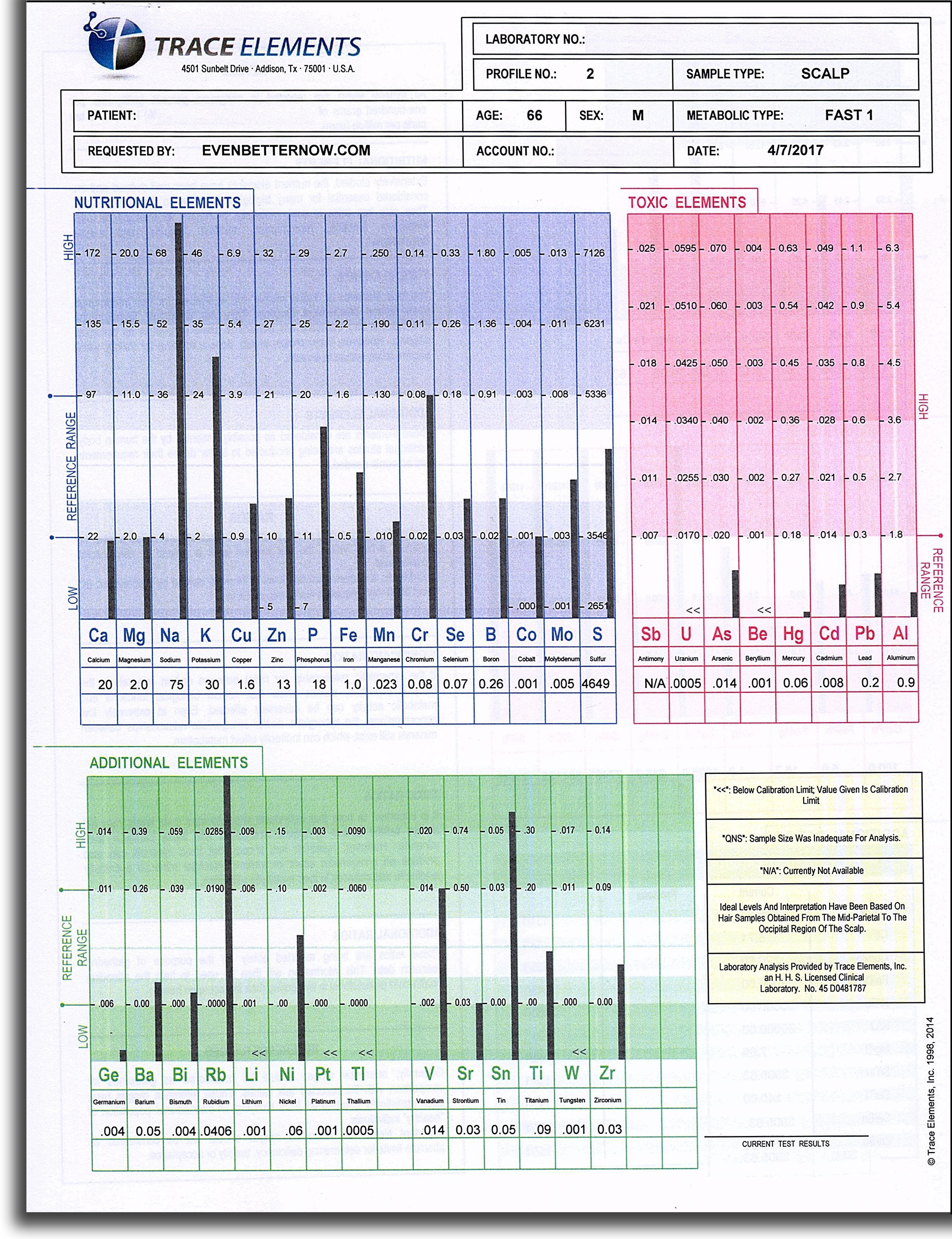
Hair Tissue Mineral Analyses (HTMA) A tissue mineral analysis or hair analysis provides a unique reading of heavy metal and mineral levels in the cells over a two to three month period. It takes into consideration that toxins are stored in the tissues of the body, not in the blood. For instance, you can have normal copper levels in the blood, but high copper levels in the tissues. The reason hair is used for testing mineral status and metabolic activity is because of its very nature. Our hair is formed from clusters of specialized cells that make up the hair follicle. During the growth phase, the hair is exposed to the internal environment such as blood, lymph and extra-cellular fluids. As the hair continues to grow and reaches the surface of the skin, its outer layers harden, locking in the metabolic products accumulated during the period of formation. This biological processs provides a blueprint and lasting record of metal content and nutritional metabolic activity that has occured during this time. The precise analytical method of determining the levels of minerals in the hair is a highly sophisticated technique: when performed to exacting standards and interpreted correctly, it may be used as a screening aid for determining mineral deficiencies, excesses, and/or imbalances. HTMA provides you and your healthcare professional with an economical and sensitive indicator of the long-term effects of diet, stress, toxic metal exposure and their effects on your mineral balance that is difficult to obtain through other clinical tests. It is important for the attending healthcare professional to determine your mineral status as minerals are absolutely critical for life and abundant health. They are involved in and are necessary for cellular metabolism, structural support, nerve conduction, muscular activity, immune functions, anti-oxidant and endocrine activity, enzyme functions, water and acid/alkaline balance and even DNA function. Many factors can affect mineral nutrition, such as: food preparation, dietary habits, genetic and metabolic disorders, disease, medications, stress, environmental factors, as well as exposure to heavy metals. Rarely does a single nutrient deficiency exist in a person today. Multiple nutritional imbalances however are quite common, contributing to an increased incidence of adverse health conditions. In fact, it is estimated that mild and sub-clinical nutritional imbalances are up to ten times more common than nutritional deficiency alone. |
Introducing the Comprehensive
Hair Tissue Mineral Analysis
|
A hair analysis usually needs to be obtained through a health care professional (which can be expensive). However, we offer a service that allows you to get a comprehensive hair tissue mineral analysis from a federally licensed laboratory called Trace Elements, Inc. Each hair analysis contains a detailed 10-15 page report from the laboratory itself, which shows bar graph readings indicating high, low and reference range levels for toxic metals, essential minerals and significant mineral ratios. |
|
| It also includes a metabolic profile, recommendations for diet and supplements based on individual results. |
Unlike some labs that test hair tissue analysis, Trace Elements, Inc. does not wash the hair at the lab. Washing the hair removes some of the loosely bound minerals and can reduce some mineral readings by 50 percent or more. The hair sample is prepared in their licensed clinical laboratory by using a series of chemical and high temperature digestive procedures. Testing is then performed using highly sophisticated detection equipment and methods to achieve the most accurate and precise results.
The Comprehensive Hair Tissue Analysis report details graph results for 8 toxic heavy metals/elements, 15 nutritional minerals/elements, 15 additional elements, 7 significant mineral ratios, and 9 toxic metal ratios. Once you purchase the hair analysis from us, we send you a hair sample kit with instructions on how to take the hair sample.
|
To view a sample of the bar graph measurements for each mineral element and significant ratios, click here or the bar graph images above. Nutritional Elements: Extensively studied, the nutrient elements have been well defined and are considered essential for many biological functions in the human body. They play key roles in such metabolic processes such as muscular activity, endocrine function, reproduction, skeletal integrity, and overall development. Toxic Elements: The toxic elements or "heavy metals" are well-known for their interference upon normal biochemical function. They are commonly found in the environment and therefore are present to some degree, in all biological systems. However, these metals clearly pose a concern for toxicity when accumulation occurs to excess. Additional Elements: These elements are considered as possibly essential by the human body. Additional studies are being conducted to better define their requirements. Significant Ratios: If the synergistic relationship (or ratio) between certain minerals in the body is disturbed, studies show that normal biological functions and metabolic activity can be adversely affected. Even at extremely low concentrations, the synergistic and/or antagonistic relationships between minerals still exist, which can indirectly affect metabolism. Toxic Ratios: It is important to note that individuals with elevated toxic levels may not always exhibit clinical symptoms associated with those particular toxic minerals. However, research has shown that toxic minerals/metals can also produce an antagonistic effeect on various essential minerals, eventually leading to distrubances in their metabolic utilization. To view a sample of the detailed explanation of results patient report, please click here. For a complete overview of the various sections covered in the Comprehensive Hair Analysis Report, please click here. To view complete details of the elements measured and to order the Comprehensive Hair Mineral Analysis, please click here. For a list of FAQ’s about hair analysis, please click here. Once you purchase the hair analysis from us, we send you a hair sample kit with instructions on how to take the hair sample. You then send the hair sample to the Trace Elements lab, and the lab sends us the detailed report/results, which we then mail to you (there is an option for emailing the results as well to save time). |
 |
To purchase a comprehensive Hair Tissue Mineral Analysis (by Trace Elements, Inc.), please click here or call 520-877-2637. |
| For a list of Commonly Asked Questions about hair analysis, please click here. |
| Want to Ask a Question about Hair Analysis? Email your questions by clicking here. |
Test for Measuring Your Body's pH |
| Your bodily pH levels are a good indication of how healthy you are. The more acidic you are, the more toxic and ill you are likely to be. Restoring the alkaline body pH is one of the most important steps for your health. Below is a product you can use to measure your pH levels: |
VAXA® pH Test Strips™ |
 |
VAXA® pH Test Strips™ are an accurate and convenient way to measure the body's pH. The easiest way to measure the body's pH is to measure the first mornings urination with a test strip. It has been clinically established that the urine pH is an accurate reflection of the whole body tissue pH. The urine pH directly correlates to both oxygen levels and soft tissue levels of minerals such as calcium, magnesium, and trace elements. How to Test Your Urine pH The best time to measure tissue pH is your first urination of the morning. More specifically, the first urination after 5 AM. Simply take a plastic cup or small clean container and fill it with urine. Then take a test strip and test it with the pH of the fluid in the container. You should immediately see a change in color which you can then match against the color of the chart given in the test kit. When you check your first urine pH in the morning, your pH should be between 6.4 and 7.0. If the first morning urine pH is acidic (a pH below 6.4), this indicates the body is in a state of physiological disregulation due to lack of sufficient minerals which are needed to properly carry out thousands of basic cellular functions. A lack of sufficient minerals is almost always indicative of heavy metal toxins within thebody, which bind up the receptor sites so that minerals cannot be absorbed. Therefore, the immediate goal is to restore a consistent alkaline first morning urine pH by detoxifying the body of heavy metals and chemicals, and by taking alkalizing supplements. |
Test for Candida Yeast |
| Try this simple test to see if you have a candida yeast infection: |
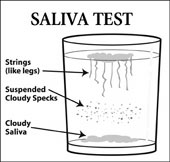
First thing in the morning, before you put ANYTHING in your mouth, get a clear glass of water. Work up a bit of saliva, and then spit into the water. Check the water every 15 minutes or so for up to an hour. If you have a problem with candida yeast overgrowth, you will see strings (like legs) traveling down into the water from the saliva floating on the top, or "cloudy" saliva will sink to the bottom of the glass, or cloudy specks will seem to be suspended in the water.
|
| If there are no strings and the candida is still floating after one hour, you probably have candida under control. While using a good antifungal, you can continue to test yourself. You will start to see fewer and fewer "strings" hanging down. |
Test for Lyme Disease |
| IMPORTANT TIP: If you have been diagnosed with ALS, you should be tested for Lyme Disease. There have been cases of people being misdiagnosed with ALS, when in fact they had Lyme disease. |
It is essential to find a doctor who is an expert in Lyme Disease. To find a doctor in your area who is "Lyme literate", call the Lyme Disease's toll-free number at 888-366-6611. They are a non-profit organization that provides information about Lyme and its treatment, and referral to doctors in various areas of the US. They also have a wealth of information on their website at www.lymediseaseassociation.org. Related Link: Plt Blood Test The PLT blood test also known as the platelet blood test is done to count how many blood platelets there are in our blood. Visit our report on Diet for Neurological Health. |
More Information on Alternative Support Therapies for ALS |
Other Useful Information for People with ALS |
Useful Tests Detoxification Therapy pH Balance Therapy Antioxidant Therapy Herbal Therapy Vitamins and Minerals Viral & Bacterial Support Supportive Supplements ALS Links and Resources |
Causes of ALS Early Symptoms of ALS Genetic Testing for ALS Diagnosing ALS ALS and Dental Amalgams Dietary Regimen for ALS Medications for ALS Stem Cell Therapy |
Thank you for visiting our page on Tests for ALS!
|
 FEATURE ARTICLES