
Diet for Interstitial Cystitis |
 |
After reading this article on diet for interstitial cystitis, be sure to visit our Natural Guide to Recovery report for lasting relief from IC! |
Interstitial Cystitis is an autoimmune condition where the immune system inflames the lining of the bladder and creates food sensitivities and allergies to certain acidic foods and supplements. This “misplaced immunity” thrives in an acidic terrain. This acidic environment is created throughout the years by a large refined carbohydrate diet of processed foods and sugars. This environment is further enhanced by the elevated toxic burden of heavy metals and chemicals, antibiotic usage and even stress. It stands to reason then that one of the key areas to address for this painful bladder syndrome is to alkalize the body and flush out all these lactic acid wastes. Consequently, a diet for Interstitial Cystitis becomes very important in order to facilitate this. Unfortunately, most urologists give lists of foods to avoid. These foods are not always triggers for everyone, however. When it comes to Interstitial Cystitis, what is one person’s nectar is another person’s poison. Therefore, a genetic food map is a hit and miss proposition, at best. And, what help is it, really, if you avoid certain foods and, yet, the remainder of your diet is mainly made up of the “Typical American Diet” of acidic foods? The most effective diet for Interstitial Cystitis that we have seen is called the 70-30 diet. It is a diet that is, primarily, 70% alkaline-producing foods and 30% acidic-producing foods. This simply means that every time you look down on your plate for breakfast, lunch or dinner, you should see approximately 70% alkaline-producing foods and 30% acidic producing foods. The basic science here is that acidity neutralizes alkalinity and alkalinity neutralizes acidity. You can’t expect to have effective results with IC if your daily diet is maintaining a condition of acidosis. Many experts say that it can take 1 – 2 years to change the cellular pH and the pH of the interstitial fluids when on this diet. This makes sense because many of the people we talk to who have gone into remission or who no longer have most of their symptoms take this period of time to achieve this. Now, the next question most people have about an IC diet is: Which foods are alkaline and which are acidic? This, of course, is a great question. To see a list of different foods, you can go to any search engine – Yahoo, Google, Ask Jeeves, etc – and enter a search phrase such as “list of alkaline-producing and acidic-producing foods” into the search window. Or you can go to this website: http://www.rense.com/1.mpicons/acidalka.htm for a complete list of acid/alkaline forming foods. You will then come up with at least 4 or 5 sites that will list the foods and what they are after they are metabolized and the oxygen is burned off. From this list you can design your own diet. To make a very generic, broad statement: Mainly vegetables, fruits, nuts, seeds and some grains are alkaline. There are other foods and herbs and spices that are also alkaline. The basic American diet of refined carbohydrates, packaged foods, sugars or sugary foods, animal protein, dairy, coffee and sodas, has to go into the 30% acidic category because these all create an acidic residue ash after they are metabolized. Protein is going to be very important in order to heal - so we are not saying to become a vegetarian. Animal protein is important – especially free-range poultry, organic eggs and fresh (low or no mercury) fish. Adhering to this diet, along with proper supplementation and the decreasing of the cumulative toxic burden on the body – has shown great rewards for many folks and is waiting to help many others. |
|
Read "Along the Healing Path - Recovering from Interstitial Cystitis" This excellent book, written by Catherine M. Simone, is a must read for anyone with Interstitial Cystitis. I can honestly say, if it weren't for this book I would not be in the place I am today, which is completely symptom-free. Catherine Simone had a very severe case of IC, which she healed using the methods described in her book. "Along The Healing Path" is a holistic perpective of IC with information on various alternative treatments, herbs, and natural products. |
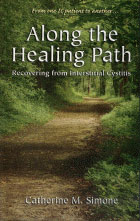 |
"Along The Healing Path" offers very helpful tips and vital information for IC sufferers “from one IC patient to another…”. |
|
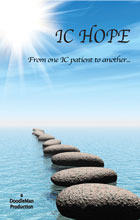 |
NEW IC DVD!!! For those of you who want to have a supportive video by Catherine Simone, we recommend her new DVD called "IC Hope - From one IC patient to another..." This DVD was created to provide the following:
|
You can check out Catherine Simone's other two books as well, To Wake in Tears: Understanding Interstitial Cystitis Genitourinary & STDs Books and Awakening Through the Tears: Interstitial Cystitis and the Mind/Body/Spirit Connection
 Genitourinary & STDs Books)
 . . |
|
Customer Feedback about "Along The Healing Path" |
 "Hi Andrea.
I am writing you again to let you know that I received the book, "Along the Healing Path" that I had ordered in the mail today. For the first time in 2 years I have a feeling of hope that I may benefit from the contents of this book. I was really feeling hopeless being in pain all the time.
I want to personally thank you on behalf of all men suffering from this terrible disease for developing your website. I'm sure it took a lot of time, research, thought and dedication to develop. It is very thorough and informative." "Hi Andrea.
I am writing you again to let you know that I received the book, "Along the Healing Path" that I had ordered in the mail today. For the first time in 2 years I have a feeling of hope that I may benefit from the contents of this book. I was really feeling hopeless being in pain all the time.
I want to personally thank you on behalf of all men suffering from this terrible disease for developing your website. I'm sure it took a lot of time, research, thought and dedication to develop. It is very thorough and informative."
"So today is the day I begin my journey to what I hope is recovery (or at least relief) from IC. I hope months from now I can write you with a smile on my face and a lack of pain in my body!
You've done a wonderful thing Andrea, to help those of us who suffer from IC have hope.
God Bless You for that!
- Sincerely, Sharyn B., Long Beach, CA
- Theresa C., Austin, TX |
|
To find supportive Interstitial Bladder Health Supplements, please click here. |
|
View or return to our page on Interstitial Cystitis - Your Natural Guide to Recovery using 7 Steps . |
 |
Have a Question? Email your questions by clicking here. |
Thank you for visiting our page on Diet for Interstitial Cystitis!
|
 FEATURE ARTICLES