Alzheimer's Natural Supportive Therapies
|
Follow the Steps Below to Stop Memory Loss and
Promote Optimal Brain Health |
|
Progressive dementia is a significant loss of brain function, or what used to be called "senility". It targets a part of the brain called the hippocampus, which is the seat of memory and intellect. A healthy brain makes a critical nerve chemical called acetylcholine. When the brain cells become damaged, they can no longer make acetylcholine.
As your acetylcholine levels drop, your brain gets inflamed, resulting in formations called amyloid plaques. This causes loss of brain cells, especially those that make new memories and retrieve old ones. And slowly but surely you develop full-fledged cognitive impairment.
|
| Highly Recommended: One thing we recommend for anyone who is experiencing symptoms of Alzheimer's is to have a hair mineral analysis test done. How can a hair analysis help you achieve better health? If we consider that diet is what we consume and nutrition is what we retain, then we can see that discovering what your body needs when it needs it is a valuable tool in creating health. A hair analysis can determine which essential minerals your body is needing more of and which toxic elements it needs to eliminate. It also provides valuable insight into your metaoblism and what dietary changes would be most helpful for you in your recovery. |
|
|
| For more information on the hair tissue mineral analysis, scoll down the page or click here. |
|
| Steps to Maintaining Optimal Brain Function |
|
| 1. Read the following books: |
The Better Brain Book, by David Perlmutter, M.D., is written in layman's terms, making it easy to understand for those of us who are less scientific.
Dr. Perlmutter addresses all the factors that can influence brain health and gives you detailed recommendations for dealing with them. |
|
Beating Alzheimer’s: A Step towards Unlocking the Mysteries of Brain Diseases by Tom Warren
Beating Alzheimer's: A Step Towards Unlocking the Mysteries of Brain Diseases
is an equally important book.It details the remarkable personal story of how one man reversed the devastating symptoms of Alzheimer’s disease.
In it, Tom outlines the step-by-step plan that he followed to free himself from the grips of this relentless disease. Tom includes the latest documented research that explains why his method worked, and as the word has spread, many physicians have contacted Tom and put their patients on his program with very positive results.
Fifteen years ago at age 50, Tom Warren received the diagnosis of Alzheimer's. He was told by his doctors that he had no more than seven years to live, and that there was nothing he or anybody else could do to stop it.
Tom had the brain scans to prove that his brain had atrophied in the frontal and temporal regions. Not only is Tom alive and well today, but he has completely reversed his brain atrophy, dementia and the diagnosis of Alzheimer's.
Up until now, the key word for cognitive progressive impairment has been "prevention”. By taking antioxidants, B vitamins, turmeric, etc., you could possibly prevent the onset of memory loss and mental decline. Nothing, however, was known about how to stop or reverse progressive cognitive dementia. Based on the experience of Tom Warren, it seems possible that progressive loss of mental functioning can be stabilized, and symptoms can even be reversed. |
|
| 2. Reduce the Load of Toxic Metals on the Body, Particularly Aluminum and Mercury |
One important risk factor for the development of a progressive brain disorder or dementia is exposure to the toxic metal aluminum. According to Dr. Perlmutter, the science connecting Alzheimer’s and aluminum appears in our most highly respected journals, including The Lancet and the journal Neurology.
According to Michael A. Weiner, executive director of the Alzheimer Research Institute, aluminum is the only metal noted to accumulate in the tangle-bearing neurons characteristic of the disease. The brains of people with progressive dementia are teeming with aluminum, and other studies have found higher concentrations of the toxic metal mercury as well.
How aluminum and mercury increase the risk of a progressive cognitive impairment is now fairly well understood. Like other toxic metals, mercury and aluminum increase the formation of dangerous free radicals, leading to the damage of the delicate brain neurons. Ways to avoid exposure to aluminum, mercury and other toxic metals include drinking purified water and avoiding foods and other substances that are high in these metals:
Mercury, besides leaking from teeth fillings, is also found in fish, cosmetics, pesticides, paint, plastics, fungicides, fabric softeners and contact lens solutions.
Aluminum is found in soft drink cans, cookware, cheeses, baking powder, deodorants, white flour, tap water, stomach antacids, toothpaste and laxatives. Avoid any food or drink that comes in an aluminum can. Use a roll-on or stick antiperspirant if it contains aluminum – inhaled aluminum particles from aerosol sprays may be the most dangerous of all because they travel directly to the brain. |
|
| 3. Test Yourself for Toxic Metals |
| How can you tell if you have been exposed to toxic metals and are carrying toxic metal ions in the body? You can use a hair tissue analysis to find out. Since health professionals agree that toxic metals are a foundational component of the development of progressive brain disorders, it can be extremely helpful to identify these toxic metals in your body. |
|
| Hair Tissue Mineral Analyses (HTMA) |
A tissue mineral analysis or hair analysis provides a unique reading of heavy metal and mineral levels in the cells over a two to three month period. It takes into consideration that toxins are stored in the tissues of the body, not in the blood.
For instance, you can have normal copper levels in the blood, but high copper levels in the tissues.
The reason hair is used for testing mineral status and metabolic activity is because of its very nature. |
|
Our hair is formed from clusters of specialized cells that make up the hair follicle. During the growth phase, the hair is exposed to the internal environment such as blood, lymph and extra-cellular fluids. As the hair continues to grow and reaches the surface of the skin, its outer layers harden, locking in the metabolic products accumulated during the period of formation. This biological processs provides a blueprint and lasting record of metal content and nutritional metabolic activity that has occured during this time.
The precise analytical method of determining the levels of minerals in the hair is a highly sophisticated technique: when performed to exacting standards and interpreted correctly, it may be used as a screening aid for determining mineral deficiencies, excesses, and/or imbalances. HTMA provides you and your healthcare professional with an economical and sensitive indicator of the long-term effects of diet, stress, toxic metal exposure and their effects on your mineral balance that is difficult to obtain through other clinical tests.
It is important for the attending healthcare professional to determine your mineral status as minerals are absolutely critical for life and abundant health. They are involved in and are necessary for cellular metabolism, structural support, nerve conduction, muscular activity, immune functions, anti-oxidant and endocrine activity, enzyme functions, water and acid/alkaline balance and even DNA function.
Many factors can affect mineral nutrition, such as: food preparation, dietary habits, genetic and metabolic disorders, disease, medications, stress, environmental factors, as well as exposure to heavy metals. Rarely does a single nutrient deficiency exist in a person today. Multiple nutritional imbalances however are quite common, contributing to an increased incidence of adverse health conditions. In fact, it is estimated that mild and sub-clinical nutritional imbalances are up to ten times more common than nutritional deficiency alone.
To get an idea of how helpful a hair tissue analysis can be, think about this: Researchers using tissue mineral analysis determined, more than 100 years after Napoloen Bonaparte's death, that he had been poisoned by arsenic. Even though his hair sample was tested more than a century after his death, it still revealed pathological amounts of arsenic that had gradually proved fatal. |
Introducing the Comprehensive
Hair Tissue Mineral Analysis |
|
A hair analysis usually needs to be obtained through a health care professional (which can be expensive). However, we offer a service that allows you to get a comprehensive hair tissue mineral analysis from a federally licensed laboratory called Trace Elements, Inc.
Each hair analysis contains a detailed 10-15 page report from the laboratory itself, which shows bar graph readings indicating high, low and reference range levels for toxic metals, essential minerals and significant mineral ratios. |
|
| It also includes a metabolic profile, recommendations for diet and supplements based on individual results. |
Unlike some labs that test hair tissue analysis, Trace Elements, Inc. does not wash the hair at the lab. Washing the hair removes some of the loosely bound minerals and can reduce some mineral readings by 50 percent or more. The hair sample is prepared in their licensed clinical laboratory by using a series of chemical and high temperature digestive procedures. Testing is then performed using highly sophisticated detection equipment and methods to achieve the most accurate and precise results.
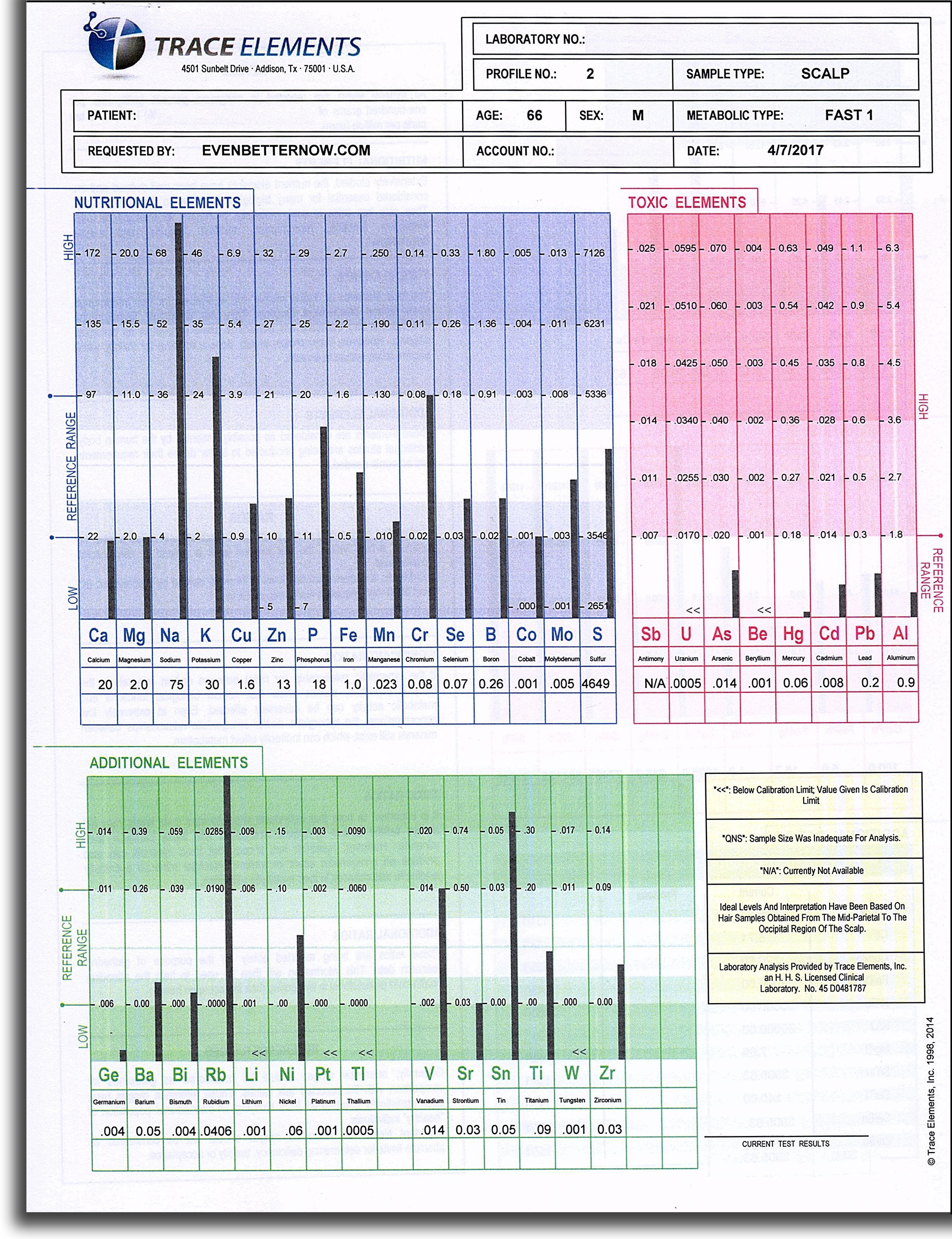
The Comprehensive Hair Tissue Analysis report details graph results for 8 toxic heavy metals/elements, 15 nutritional minerals/elements, 15 additional elements, 7 significant mineral ratios, and 9 toxic metal ratios. Once you purchase the hair analysis from us, we send you a hair sample kit with instructions on how to take the hair sample.

|
Nutritional Elements: Extensively studied, the nutrient elements have been well defined and are considered essential for many biological functions in the human body. They play key roles in such metabolic processes such as muscular activity, endocrine function, reproduction, skeletal integrity, and overall development.
Toxic Elements: The toxic elements or "heavy metals" are well-known for their interference upon normal biochemical function. They are commonly found in the environment and therefore are present to some degree, in all biological systems. However, these metals clearly pose a concern for toxicity when accumulation occurs to excess.
Additional Elements: These elements are considered as possibly essential by the human body. Additional studies are being conducted to better define their requirements.
Significant Ratios: If the synergistic relationship (or ratio) between certain minerals in the body is disturbed, studies show that normal biological functions and metabolic activity can be adversely affected. Even at extremely low concentrations, the synergistic and/or antagonistic relationships between minerals still exist, which can indirectly affect metabolism.
Toxic Ratios: It is important to note that individuals with elevated toxic levels may not always exhibit clinical symptoms associated with those particular toxic minerals. However, research has shown that toxic minerals/metals can also produce an antagonistic effeect on various essential minerals, eventually leading to distrubances in their metabolic utilization.
For a list of FAQ’s about hair analysis, please click here.
For a complete overview of the various sections covered in the Comprehensive Hair Analysis Report, please click here.
To view details of the elements measured and to order the Comprehensive Hair Mineral Analysis, please click here.
Once you purchase the hair analysis from us, we send you a hair sample kit with instructions on how to take the hair sample. You then send the hair sample to the Trace Elements lab, and the lab sends us the detailed report/results, which we then mail to you. (Please note: international customers outside of the United States will be instructed to send the hair sample to us, not directly to the lab). |
| Want to ask a question about the comprehensive hair analysis?
Email your questions by clicking here or call 520-877-2637. |
| 4. Use All Reasonable Methods to
Remove Toxins From the Body |
According to Dr. Thomas Nissen, an expert in Environmental Medicine, detoxifying the body of toxic metals is the first priority for helping people with progressive cognitive impairment. As we have seen, heavy metal toxins play a major role in brain and other neurological disorders, so neutralizing these toxins is highly important. As well, when the body is loaded with toxic metals, nutritional supplements such as vitamins and minerals are not easily absorbed – the toxic metals bind up the receptor sites in the nervous system.
According to Dr. James Balch, M.D., it is probable that exposure to excessive amounts of aluminum and mercury, especially when combined with a lack of vitamins, minerals and antioxidants, predisposes a person to developing cogntive dementia. |
|
Natural Alternatives To Traditional Chelation Therapy |
|
| The following detoxification products can be a safe alternative to traditional chelators used in chelation therapy for removing heavy metals and chemical pollutants. |
|
Purified Bentonite Bathing Clay for Detoxifying Metals and Chemicals |
|
| Sodium bentonite clay can be a very simple and effective way to remove heavy metals and chemical contaminants from the surface tissue of the body.
When you mix bentonite clay with water, it creates a large negatively charged surface area. When the body is in a tub of warm water, the warm water opens up the pores of the skin, and the positively charged toxic particles are drawn through the pores of the skin, to be absorbed by the clay.
Most chemical and metal toxins have a postive charge, whereas the clay has a negative charge. Thus, the toxins cannot resist being drawn towards the clay. Bentonite clay has a great capacity for absorbing many times its own weight in toxins. In other words, clay baths have been shown to literally pull pollutants out through the skin, getting rid of many months and years of toxic accumulations.
It is important that you find a clay that has been purified, so it contains no mold, yeast, bacteria or fungus. Also, it helps to use a clay that mixes well and disperses easily with warm water to get maximum effectiveness. Some clays do not mix well in the tub, leaving you with a cumbersome and messy clean-up. |
|
| IMPORTANT TIP: For those of you who wish to do everything possible to detoxify, to "cover all the bases" so to speak, we do recommend using Far Infrared Sauna Therapy. |
|
|
Introducing The Thermal Life® FAR
Infrared (FIR) Sauna |
Take Advantage of the Special $500 Discount Offer Mentioned Below! |
|
The Infrared Sauna has an excellent reputation for detoxifying both metal and chemical contaminants from the body. It is an excellent therapy on its own or as an adjunct to other natural methods of detoxification.
Proper FAR infrared sauna therapy can be supportive for:
- Detoxification
- Enhanced Immune System Health
- Improved Cardiovascular Health
- Stress Releif
- Weight and Cellulite Management
- Pain Relief
- Skin Beautification
|
FAR infrared saunas help to accomplish detoxification in the following manner: A layer of fat and oil exists just below the surface of the skin. The FAR infrared light resonates with the water molecules within these lipid or fat cells.
This vigorous activation of the water molecule stimulates the fat cells to excrete toxins. These toxins will be released through the skin's sweat channels as a result of the high temperature from the sauna. As sweat and oil are secreted, the toxins dissolved in them are secreted as well. By excreting these toxins and then washing them off your body, the toxic load on the body is lowered and cellular health improves.
Oil glands help remove oil-soluble toxins that the body would otherwise have a difficult time eliminating. We have created a world filled with oil-soluble toxins such as gasoline, solvents, pesticides, ingredients in toothpaste, personal care products, etc., which the body is not able to dispose of efficiently. The longer the skin is heated, the more oil-soluble toxins are eliminated.
No other sauna company that we know of knows as much about detoxification as High Tech Health, Inc. Their specialty is providing saunas that detoxify safely and effectively. Their Thermal Life® Sauna is designed to allow anyone to detoxify at a rate that is appropriate for them.
Bio-Resonance™ Heaters
The Thermal Life® Sauna utilizes specially designed Bio-Resonance™ ceramic heaters that provide the optimal level of far infrared exposure no matter where you are in your detoxification process. A special feature of the Bio-Resonance heater is the nature of the far infrared rays that is emits. FAR infrared is a band of electromagnetic energy, just as visible light and ultraviolet light are.
The difference between visible light and far infrared is that we cannot see far infrared. FAR infrared affects the body differently than ultraviolet or near infrared light. Heat lamps emit near infrared which is only absorbed by the surface of the skin. FAR, on the other hand, is absorbed into the body up to a depth of 1 and half inches. It is experienced as a softer heat sensation which is quite enjoyable.
FAR infrared rays also stimulate the production of endorphins, the "happy hormones", and have been prescribed for pain for a long time. Bio-Resonance heating technology ensures an enjoyable, detoxifying experience.
Comparing Ceramic to Carbon Heaters in FIRS
Hight Tech Health (HTH) researched "carbon heater" technology and found it to be significantly inferior to their trademarked BioResonance® emitters because carbon heaters are inefficient and poor emitters of far infrared waves. If the emitters don't produce good far infrared, then the detoxification effect is diminished. HTH emitters are alloy tubes filled with solid ceramic . The ceramic material is warmed to the temperature range where it emits the highest quality and quantity of FIR waves. (between 6-20 microns).
The surgical grade stainless steel reflectors behind the emitters reflect back into the cabin any FIR emitted from the rear of the emitters. This way, the cabin is completely filled with 100% FIR waves and none are lost into the walls of the sauna. Carbon emitters because of their poor design and emission, lose close to 50% of what little far infrared they do emit through the back walls, because there is nothing to reflect the waves back into the center of the sauna cabin.
Carbon emitters are large thin plastic or fiberglass panels with a thin layer of carbon material sandwiched in between, or lined with fabric with carbon fibers woven into the fabric, then laminated onto the panels with a wire grid behind them to heat them up. They are made large to compensate for the extreme inefficiency of far infrared light production. They take 40-45 minutes to warm up to the point where you can even get into the sauna vs. our saunas which are warm and ready to use in 10-15 minutes.
High Tech Health will not put plastic or fiberglass into their saunas because of concerns regarding possible out-gassing of chemical compounds from these panels. These types of saunas are primarily marketed for recreational use.
Another downside to carbon heaters is because of their large panel size, they produce fairly strong electromagnetic fields. HTH heaters emit extremely low levels of EMF's, about 2-4 milligauss, which is equivalent to sitting next to a reading lamp.
Carbon heaters are inexpensive to construct. They don't tend to have a long life, and can burn out in 5-6 years. HTH has never had to replace a single heater in the 14 years of selling the Thermal Life saunas. It is by far, the most durable, energy efficient and long lasting technology in the industry.
The most important four points in buying a far infrared sauna in regards to the heater technology used are:
- Strength of Infrared – is the heater effective in promoting detoxification?
- Energy Efficiency
- Durability / Long lasting
- Warm-up time
|
|
Besides linking to their site in the below-mentioned link, you can call them directly (recommended) at 800-794-5355 or 303-413-8500 and speak to one of their knowledgeable product specialists.
By mentioning our website Evenbetterhealth.com, you will receive the discount when you place the order from them. As well, High Tech Health offers a 30 day money-back satisfaction guarantee, so you can try it risk free. They also offer a lifetime warranty against defects in workmanship of the cabin, the heaters, and the electrical components. |
| 5. Reduce Inflammation, Limit Free Radical Activity and Enhance Nerve Function. |
|
| Ginkgo Biloba (Standardized Extract) |
Ginkgo Biloba is the world's number one herb for mental nourishment. The use of ginkgo goes back centuries, and Ginkgo Biloba is licensed in both France and Germany for the treatment of a variety of brain disorders.
A German study done in 1994 involving forty patients found that 240 mg of Ginkgo Biloba taken daily for three months produced measurable improvements in memory, attention and mood. |
At the completion of the study, the group receiving the gingko actually improved their mental functioning, as demonstrated on a standardized psychological test, while the placebo group showed a progressive decline.
According to Dr. Perlmutter, the authors of the study concluded that Ginkgo Biloba was "safe and appears capable of stabilizing and...improving the cognitive performance and the social functioning of demented patients for 6 months to 1 year".
Be sure to use a Ginkgo Biloba product that has been standardized to 24% Ginkgolflavonglycosides and 6% Terpene Lactones. Suggested use is 120 mg two to three times a day. |
|
| Alpha Lipoic Acid |
According to Dr. David Williams, researchers in Germany discovered that when patients with progressive mental decline were given alpha lipoic acid, their condition stabilized and they didn’t experience any loss of cognitive function. He stated that there is no drug therapy that can totally halt the progressive loss of mental function as alpha lipoic acid was able to do in the German study.
There are two forms of alpha-lipoic acid, an S-form and an R-form. Researchers believe that R-Form may be "up to 12 times more effective" than regular alpha lipoic acid which contains a synthetic by-product. |
|
| Acetyl-L-Carnitine |
| Acetyl-l-carnitine is readily converted into the important neurotransmitter acetylcholine, which is known to be extremely deficient in patients with progressive dementia. According to Dr. Perlmutter, researchers at the University of California, San Diego, have found a striking reduction in the rate of mental decline in younger patients taking acetyl-l-carnitine over a one year period. Results of L-carnitine supplementation include improved memory, delayed progression of mental decline and improvement in overall performance. |
|
| Vitamin E |
| Vitamin E is a potent antioxidant that slows free radical damage. It has been widely studied in the last decade as a therapy for progressive dementia. In a study published by the New England Journal of Medicine in 1997, patients given vitamin E over a two year period had better results in terms of cognitive function and longevity than those on the “Alzheimer’s drug” Selegiline. Vitamin E slowed the advancement of progressive dementia by 25 percent. |
|
| Coenzyme E1 |
In a clinical trial in Austria, NADH was found to improve cognitive performance as measured by two standardized performance tests. Those patients not receiving Coenzyme E1 continued to decline.
The patients did not suffer any side effects. Co-E1 is an essential ingredient for increasing the energy production of cells in the brain, and it is also a powerful antioxidant. |
|
| Lecithin |
According to Dr. Perlmutter, extensive medical literature has appeared describing the important role of lecithin in preserving normal brain function.
Elite® Lecithin, particularly one of its components, phosphatidylserine, improves brain cell communication and memory, and has shown benefits for early-stage cognitive decline. |
|
| Vitamin B12 |
| Several studies have stated people with Alzheimer’s disease have significantly lower blood levels of vitamin B-12. Those with the least vitamin B-12 in their blood have the most brain impairment. And Vitamin B-12 is notoriously difficult for us to absorb: besides being the biggest of all vitamin molecules, many best-selling drugs block B-12 absorption, and as we age our stomachs often secrete less acid so we can’t digest B-12 as well as we used to. Also, older stomachs often secrete less “intrinsic factor”, a substance essential for B-12 absorption. And once you are deficient, it is extremely difficult to correct. |
|
| Turmeric |
Turmeric (also known as curcumin) is one of nature's most powerful healers and has been used for over 2500 years in India. Turmeric was shown by researchers at the University of California to protect the brain from cognitive impairments.
Progressive cognitive impairment is extremely rare in India, where they consume a lot of turmeric. |
|
| Huperzine A |
According to Dr. James Balch, one clinical trial found that 58 percent of people studied had significant improvements in memory as well as mental and behavioral function, from taking 200 mcg of Huperzine A twice a day for 8 weeks.
This was considered a statistically significant improvement. |
|
Memory Quiz: |
Is it Cognitive Dementia or Simple Forgetfulness? |
| People often experience momentary forgetfulness, or they are unable to think of the correct word from time to time, and they start to wonder if they are getting Alzheimer’s. There are distinct differences between Alzheimer’s and everyday forgetfulness. Here's how to tell the difference: |
- You forget things once in a while - NO
- You forget things often, never recall things and ask the same question over and over – YES
- You forget where you put your eyeglasses - NO
- You forget that you wear eyeglasses – YES
- You can't find your car keys - NO
- You can't find your car keys because you left them in the sugar bowl, or in the refrigerator - YES
|
| Other Symptoms of Cognitive Dementia Include: |
- Sudden mood swings
- Impaired judgement
- Difficulty following directions
- Difficulty finding the right word
- Behavior changes
- Hallucinations and delusions
|
Thank you for visiting our page on Alzheimer's Natural Supportive Therapies! |
|



 FEATURE ARTICLES